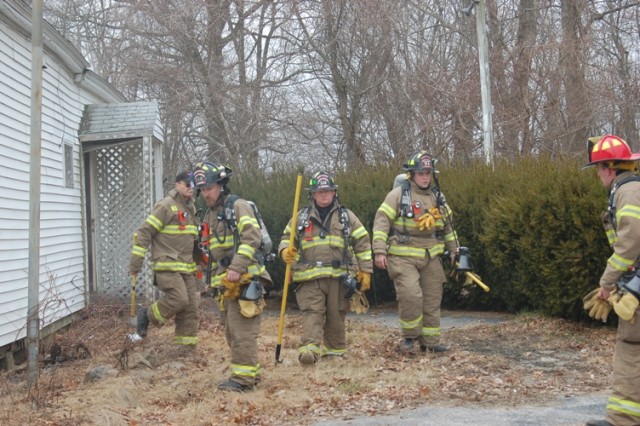
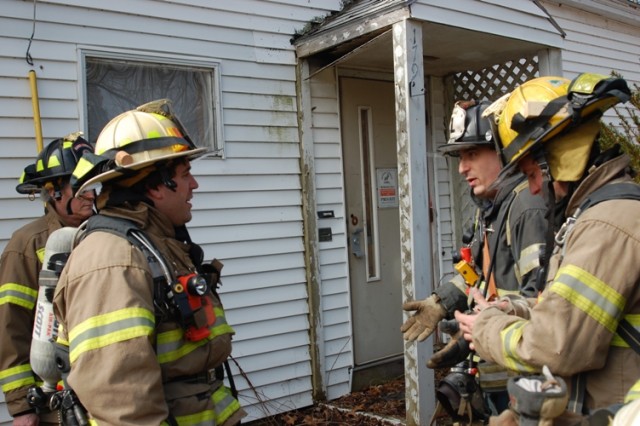
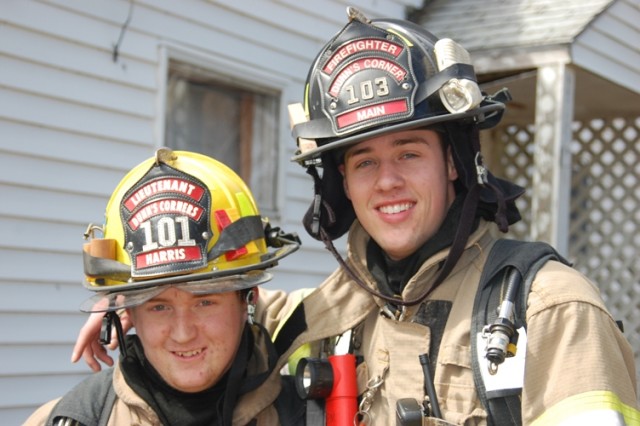
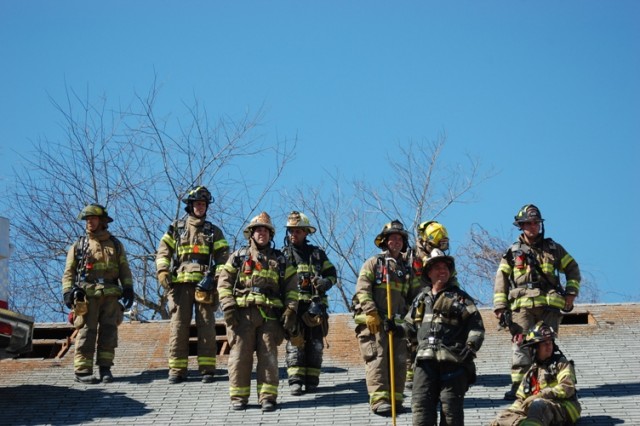
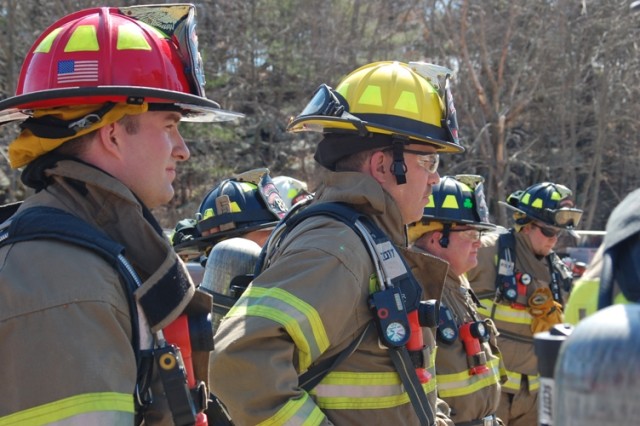
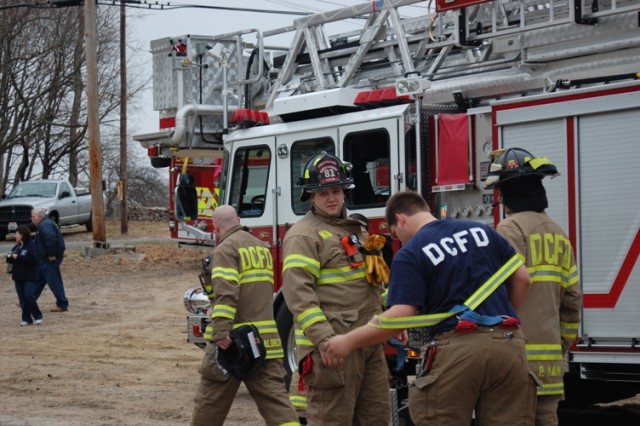
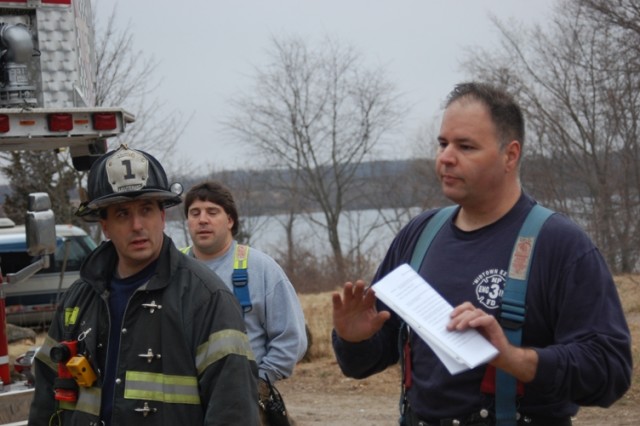
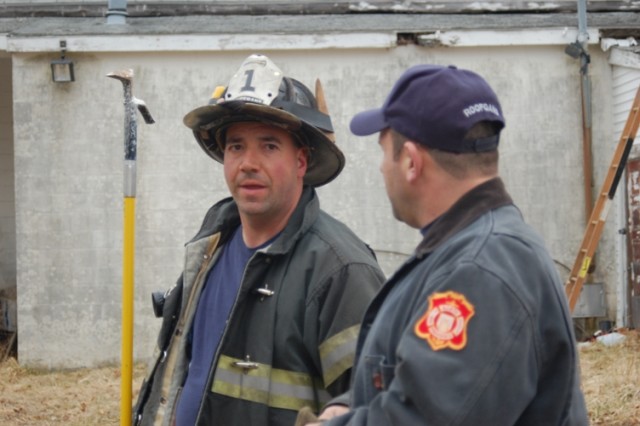
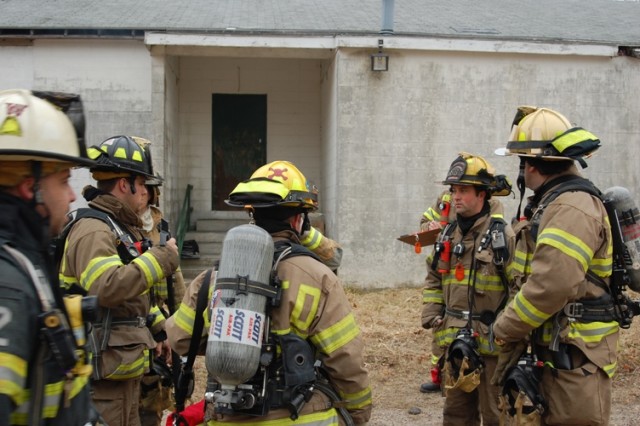
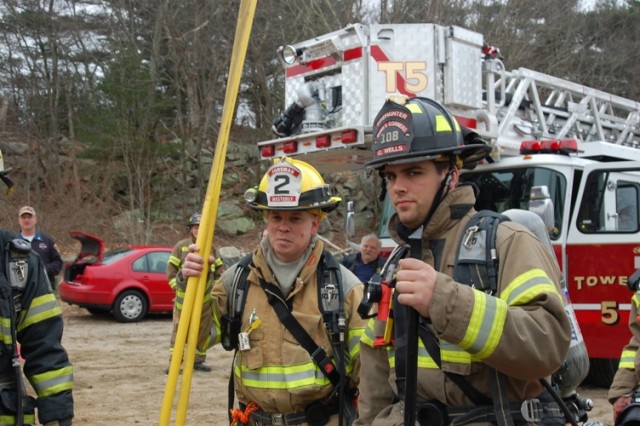
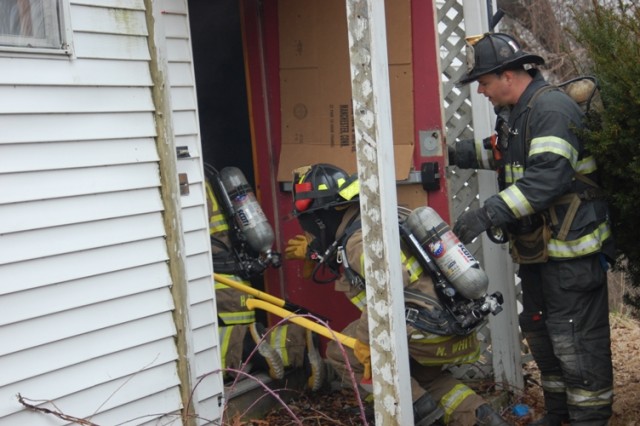
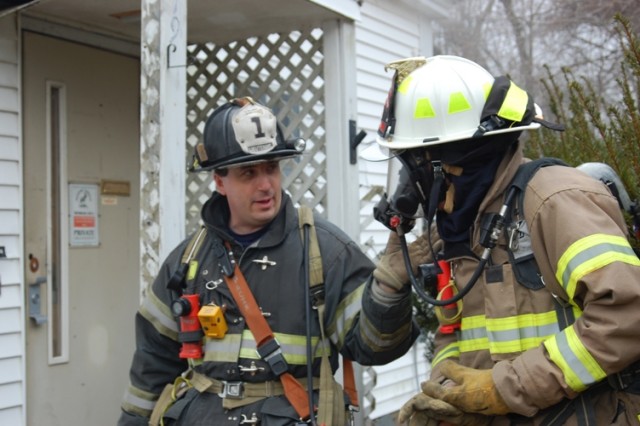
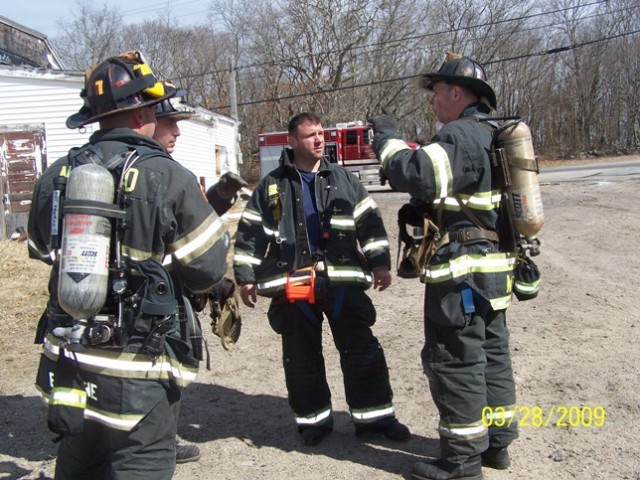
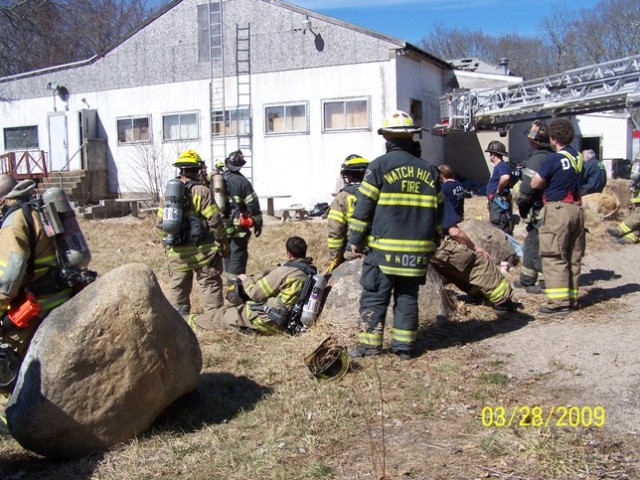
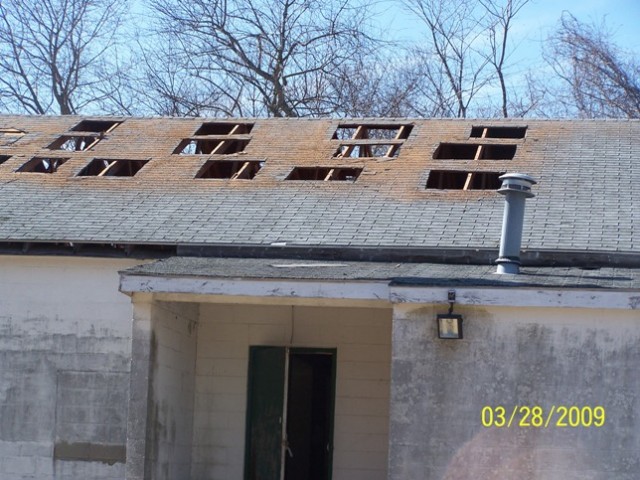
On Saturday, March 28th from 0800 - 1600 firefighters from the Dunn's Corners FD, Watch Hill FD, and Westery FD trained at the Moose Lodge. A special thanks to the property owners Seth and Lana Andrew for donating the building for training purposes. This was a practical for a class offered through the Rhode Island Fire Academy called "Beyond the Basics / Fireground Support Operations".
The course is designed to build on the basic skills we had acquired in the Firefighter Level 1 and Level 2 programs. The goal was to make us a "Streetsmart" and "Toolsmart" firefighter by applying solid techniques and tricks-of-the-trade learned through experience.
The course consisted of 5, 3-hour classroom sessions taught at the Dunn's Corners FD Station #1. The instructors for the class were Lieutenants of the North Providence FD, Lt. Jeff Pacia and Lt. Dave DeStefano. The classroom sessions covered topics such as forcible entry, search and rescue, ventilation, and building construction. Our instructors reinforced the importance of performing "size-up", not only at the beginning of an incident but consistently throughout it.
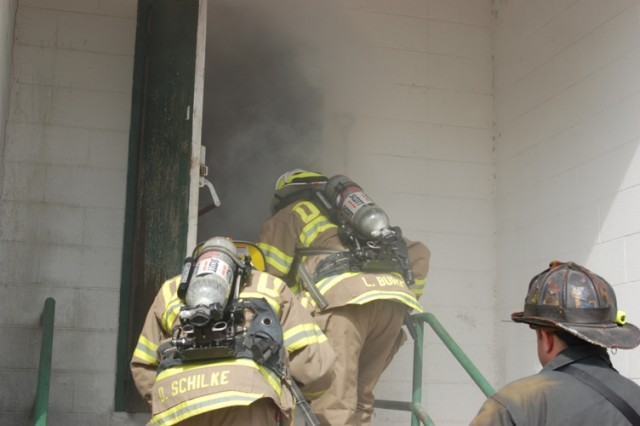
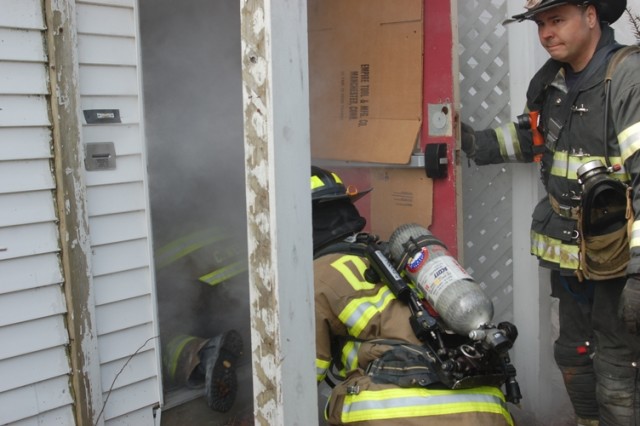
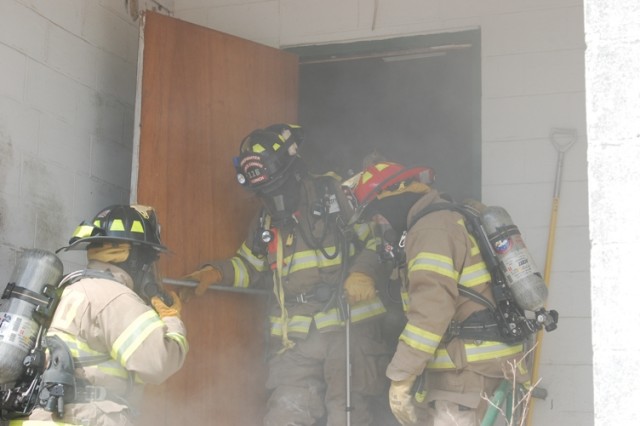
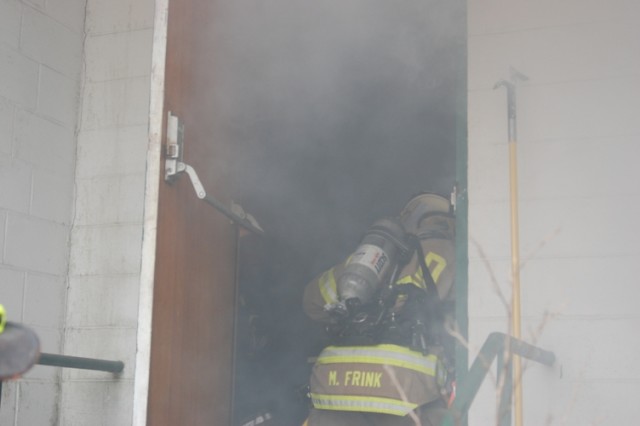
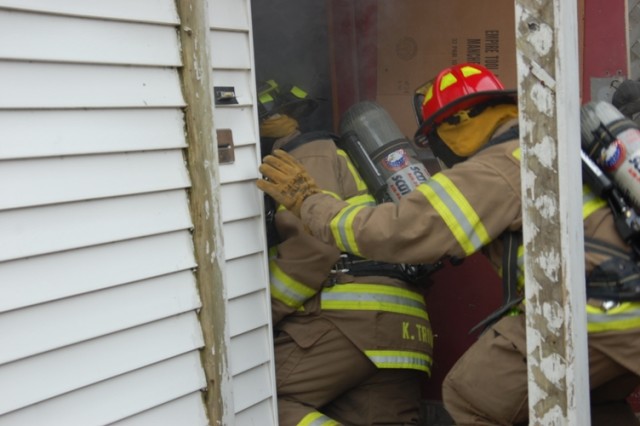
For the practical, 4 instructors were present and were all from the North Providence FD: Lt. Jeff Pacia, Lt. Dave DeStefano, Lt. Lou Charello, and Lt. Jay Petrillo. During the training, various drills were performed. Smoke machines were also used to fill up the building in order to make visibility conditions very poor which is typically the scenario during a structure fire.
One of the drills consisted of two fireground search and rescue evolutions. There are two objectives for conducting a fireground search: 1) to search for life and 2) search for the seat of the fire. For one evolution, two firefighters (at a time) in full PPE including SCBA performed a small area search. Wires were present in the room and represented a potential entanglement scenario. We also performed a large area search in another section of the building, located a trapped victim, and removed them to safety. Both of these drills allowed us to practice our different search techniques and allowed us to perform air management with our SCBA. It's very important for use to continually monitor our air supply during a fire in order to make sure we know how much air it took for us to get to a certain point in the room so that we can assure ourselves that we have enough to get back out. Life safety on the fireground is our number one priority.
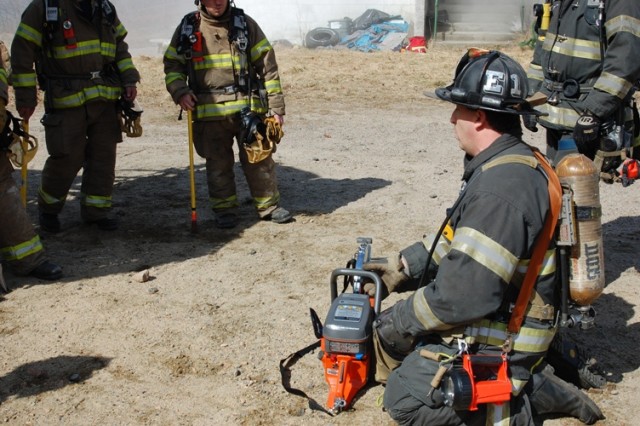
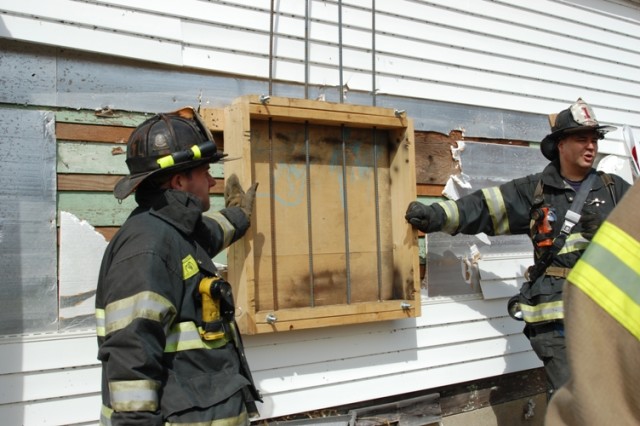
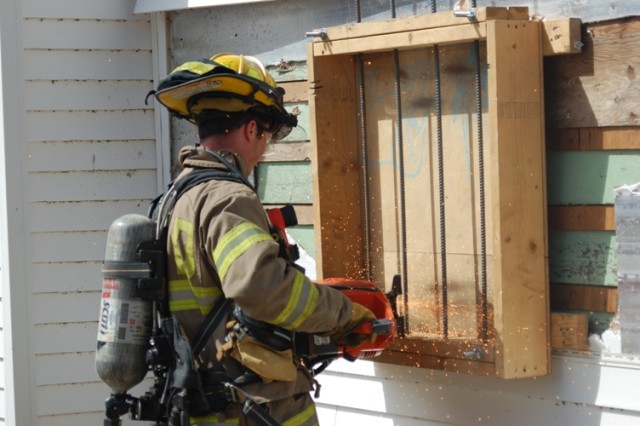
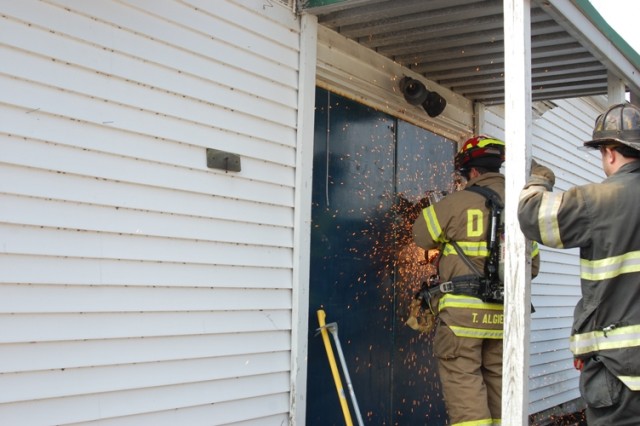
Forcible entry drills also were conducted. Forcible entry is a technique that we may need to use during a fire, rescue, and sometimes during odor investigations or alarm malfunctions. It's a technique that is used to gain access to a structure whose normal means of access are either locked, blocked, or non-existent. We forced exterior metal doors using cutting tools such as the K12 rotary saw and flat-head axe and wooden & metal interior doors using prying tools such as the hydraulic ram and the Halligan bar and striking tools such as the maul axe. We also cut high security window bars using the rotary saw equipped with a metal cutting blade. Another drill consited of using the K12 rotary saw to make entry through an exterior door with a lock bar.
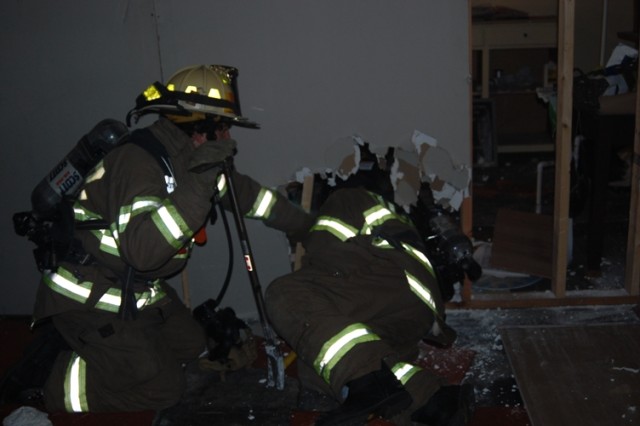
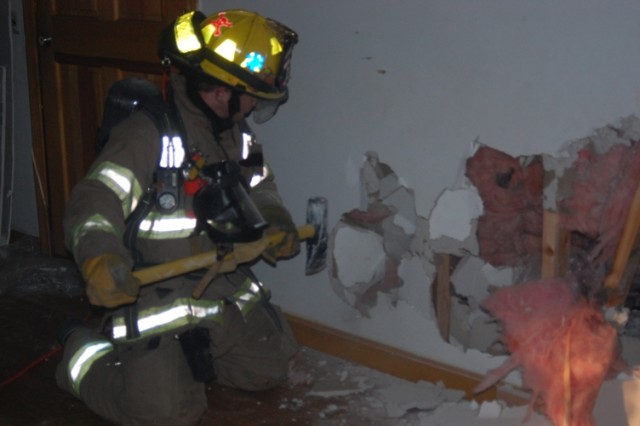
Wall breaching tactics were also practiced. Scenarios may exist where a firefighter cannot escape a burning room via a window or a door due to the presence of fire; their only means of egress may be to go through an interior wall into an adjacent room or through an exterior wall to get to safety. As a result, we practiced our skills on wall breaching. Interior wall breaching of gypsum partition walls was accomplished using a flat-head axe and a Halligan bar and exterior concrete wall breaching was accomplished using a sledgehammer.
We also practiced overhaul operations. Overhaul operations consist of searching for and extinguishing hidden or remaining fires. Although this wasn't a "live fire" training, it still provided us with an excellent opportunity to master the techniques that we would use to pull ceiling panels and open up walls to check for fire extension. We used pulling tools such as the Pike pole and multi-purpose hooks for this drill.
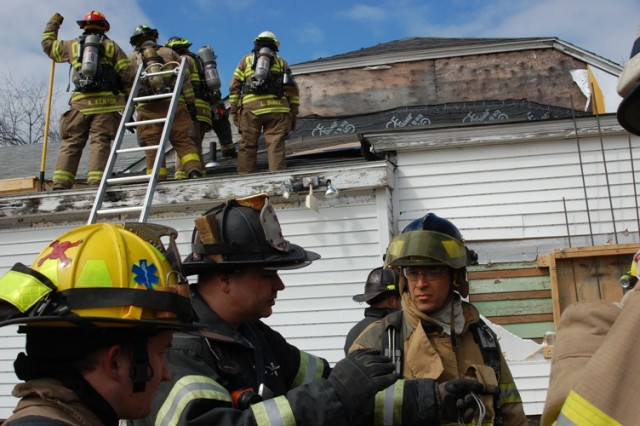
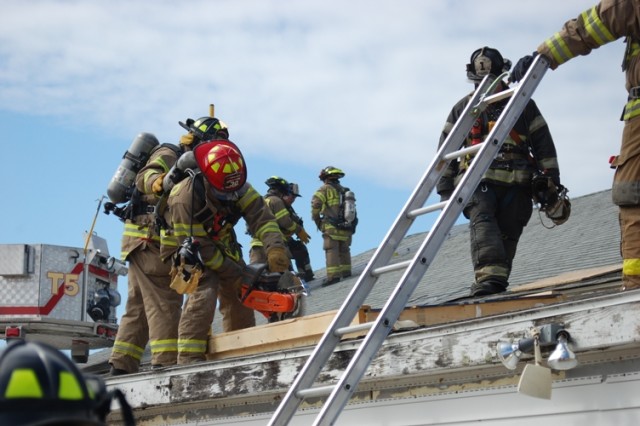
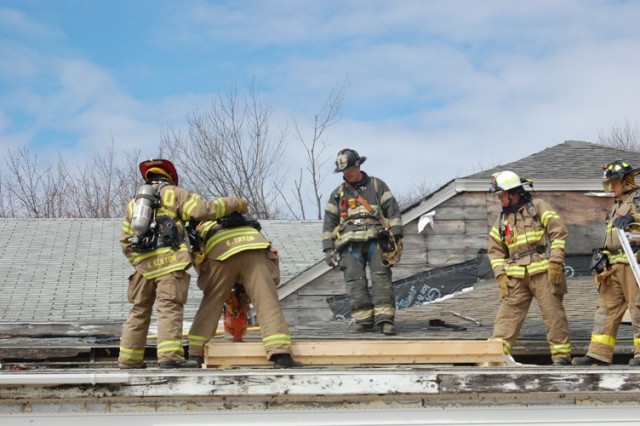
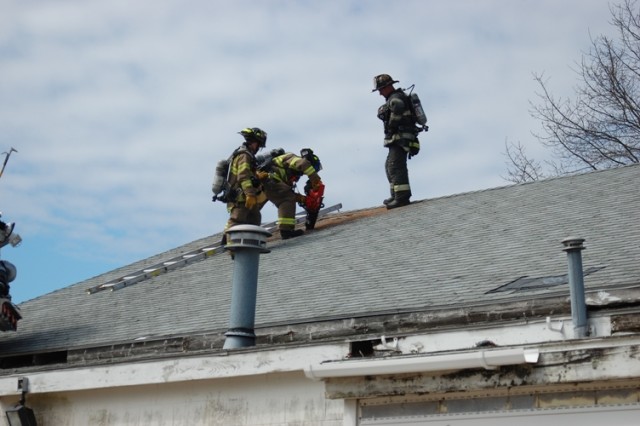
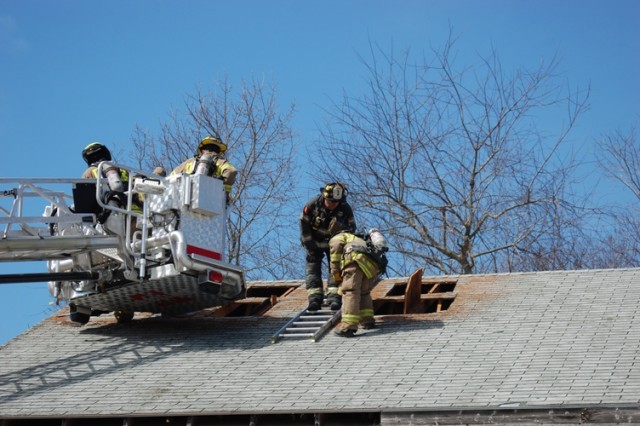
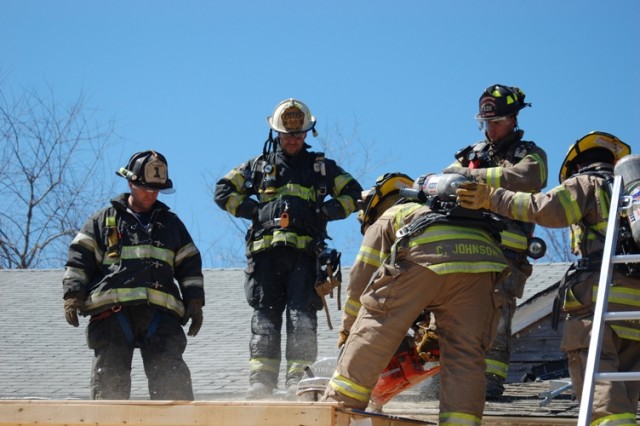
Outside we practiced techniques to accomplish vertical ventilation on the flat and pitched portions of the roof. During a fire, vertical ventilation is performed above the fire to remove the heated air, smoke, and gases from the structure and to replace them with cooler air. The importance of ventilation cannot be overlooked. It increases our visibility inside in order to quicker locate the seat of the fire, decreases the danger to trapped occupants by channeling away hot, toxic gases and reduces the chance of flashover or backdraft.
Ventilation was accomplished using manual and power tools like a maul axe, the K12 rotary saw, and the Cutter's Edge bar saw. Louvered cuts were made on the roof when cutting through plywood with the bar saw. These cuts were made between the rafters rather than beside them and as a result, the panels were hinged on the rafters. This allows us to accomplish vertical ventilation during a fire without dropping the cutout section of roof down below inside the structure, potentially on an interior team of firefighters.
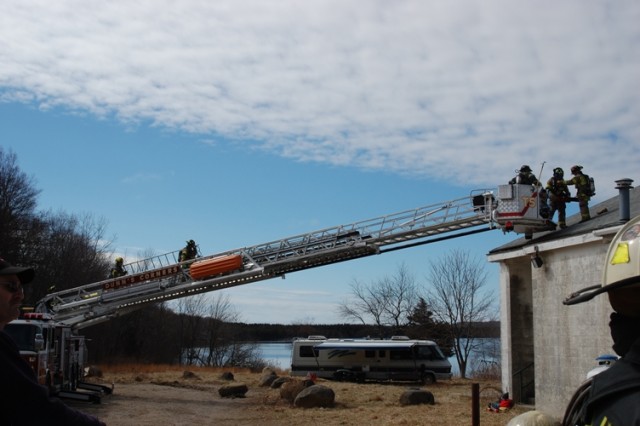
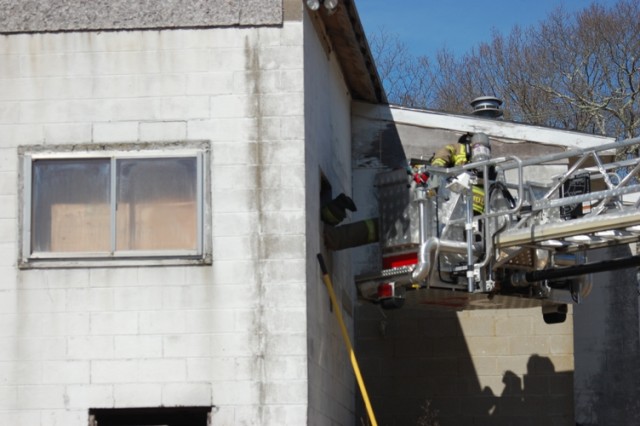
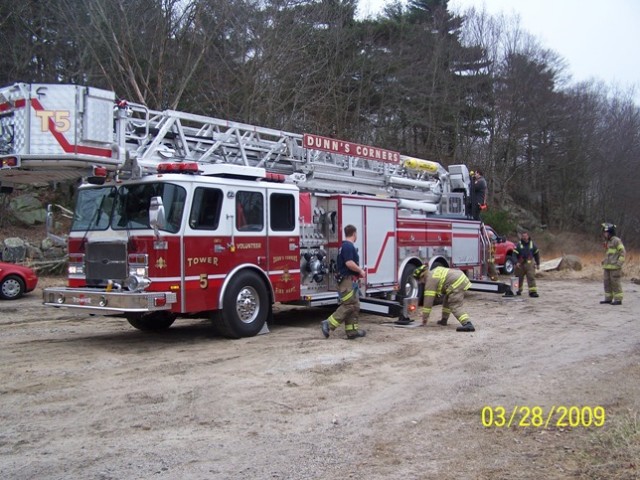
The training also provided us with some valuable hands-on with our new piece of apparatus, Tower 5. Not only did we ventilate the roof as noted above, but many of us had the opportunity to venitlate the roof from the bucket of the tower.
Our last drill of the day consited of the one firefighter extension ladder (24-foot) raise. Extension ladders may be used to rescue victims, attack the fire, perform horizontal ventilation, and / or provide a secondary means of egress.
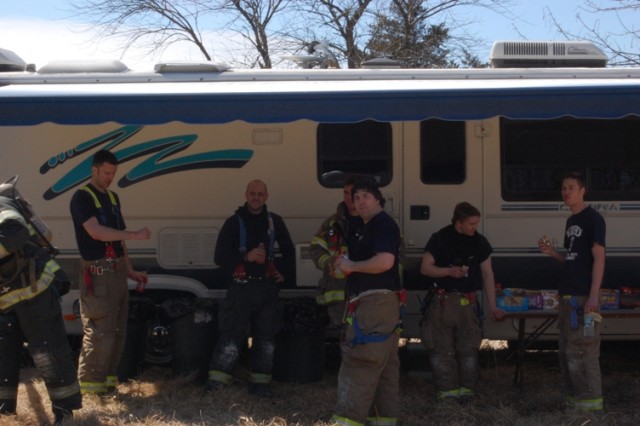
All in all the class was a success. It allowed us to further master our firefighting skills and it provided us with an opportunity to work with firefighters from neighboring departments. Again, a special thanks to North Providence FD Lieutenants David DeStefano, Jeff Pacia, Lou Charello and Jay Petrillo for passing along knowledge and tips / tricks they have gained on the job. Following the drill, all hands returned to the station and shared a well earned spaghetti & meatball dinner, thanks to the Ladies Auxiliary.
Also, a special thanks to Department Photographer / Firefighter Emily Schwabe and Ladies Auxiliary member Cheryl Algiere for the photos. |